

| New Product Development
From Insights to Impact:
Grounding New Product Development in Consumer Reality

The stakes of New Product Development (NPD) have never been higher. A failed launch isn’t just a disappointment, it’s a multi-million-dollar write-down, a hit to brand equity, and a green light for competitors to capture market share.
In a marketplace defined by far reaching shifts in consumer behavior, relying on gut instinct is an expensive gamble.
Whether for a new physical product or a new service, or some combination of the two, long-term success requires grounding your NPD pipeline in the actual needs, hopes, frustrations, and desires of the consumer. To minimize risk and maximize new product success, a structured, consumer-centric research framework is essential. Here is a research journey that transforms consumer insights into market-ready products.
Exploration and Definition
Every New Product Development (NPD) journey begins by understanding the consumer's reality. You cannot solve a problem you don't fully understand. At this stage, the goal is to identify both the rational and emotional needs of your target market.
- Qualitative research allows you to measure and observe consumers in their natural environments. By seeing how they interact with existing products, you can identify "whitespaces," those gaps where current market offerings are failing to meet consumer aspirations or solve their pain points.
- Ethnographic Studies: Watching how consumers interact with products in real-time in real environments.
- In-Depth Interviews (IDIs): Having one-on-one conversations to uncover underlying motivations.
- Online Diaries: Capturing daily habits, pain points, and frustrations over time.
This exploratory phase is designed to identify "whitespaces"—those critical gaps where current market offerings fail to meet consumer aspirations or solve their everyday problems.
The Discipline of Innovation
Once the consumer gaps are identified, the creative process can begin. The goal is to generate a high number of potential solutions (i.e., rough ideas, fragments of ideas, etc.) for possible new products.
- Ideation sessions focus human creativity on the specific issues and desires identified during the exploration phase. These sessions often involve a mix of stakeholders—including R&D, brand managers, and executives—alongside highly creative external thinkers (such as "Imaginators®"). By anchoring this collaborative brainstorming in real-world consumer needs, teams can generate hundreds of raw ideas and concept fragments that are inherently relevant to the target audience.
- Concept Creation. The next step is to shape those raw ideas into integrated concepts where the ideas come together into a sensible whole. Typically, a small team (a researcher, a marketing person, and a product expert—no more than 3 or 4 people) goes through all of the new product ideas and idea fragments, to build integrated and logical new product concepts. This team will typically come up with 25 to 50 rough new product concepts.
The Concept Winnowing Process
The next step is a rigorous filtering process to identify the high-potential concepts. This is where data shifts from qualitative inspiration to quantitative fact.
- Concept Screening: Through online surveys, hundreds of category consumers evaluate batches of early-stage concepts. By measuring purchase interest, frequency, uniqueness, and price acceptance, you can quickly identify which ideas have the highest potential.
- Concept Refinement: The survivors of the screening process undergo qualitative refinement. Through depth interviews, you can ensure consumers actually understand the imagery and messaging before you commit to large-scale testing.
Proving Potential: The Power of Analytics
To prove a product will actually sell, the concept test results are combined with the results of in-home usage product tests (or product acceptance research for new services) to forecast actual retail sales given pricing inputs and competitive brands.
- Concept Testing. We recommend a monadic research design for final concept testing. In this setup, each consumer evaluates only one concept, which prevents the “interaction” bias that occurs when people compare multiple options. The monadic concept testing will provide clear indications of which concepts have the greatest potential.
- In-Home Usage Testing (iHUT). Considered the gold standard of product testing, iHUTs place prototypes directly into consumers' daily lives over a period of time defined by the usage cycle. Consumer feedback provides data and repeat-purchase indicators necessary for new product sales forecasting.
- Brandname Testing. Selecting a good brand name is a crucial step in new product development. Ideally, the new name is appealing, memorable, pronounceable, unique, and fits the new product.
- Package Design Testing. Using simulated retail environments, good package testing can increase a new product’s chances of success. This is especially true if the new product will be introduced with low levels of advertising support.
- Volumetric Sales Forecasting. By combining concept testing and in-home usage test results, historical metrics, and repeat-purchase estimates, the sales volume for a new product can be predicted with reasonable accuracy. Ideally, this sales forecast would be the final determinant of the go-to-market decision.
Conclusion
From initial qualitative exploration to monadic concept testing and volumetric sales forecasting, a structured, step-by-step approach significantly improves your odds of in-market success. Creativity sparks the NPD idea, but analytic rigor and understanding the psychology of the consumer ensure it survives.
Applied Creativity Process

Decision Analyst’s Applied Creativity Process is different from traditional innovation methods. The goal is to focus human creativity on solving consumers’ problems, identifying unmet needs, and discovering new opportunities.
This process is based on a problem-solving model where sessions follow a proprietary creativity guide that is objectives-driven and exercises-oriented, rather than discussion-based. Creativity must have focal points, targets, and objectives so that the final new product ideas are relevant and viable.
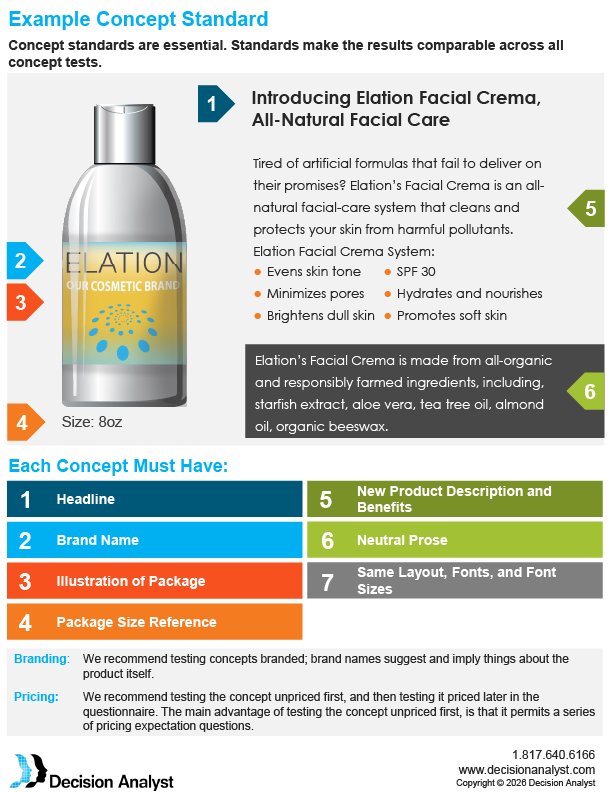
Download Our Free Example Concept Standard
Concept standards are essential. Standards help achieve consistency from concept to concept. Standards make the results from testing Concept A comparable to the results of testing Concept B.
Download a pdf of our example concept standard.
New Products Development Team


We Are Here To Help
Decision Analyst is a leading global marketing research and analytical consulting firm with over 45 years of experience in Shopper Insights and Customer Experience Optimization. Our staff has helped hundreds of companies improve the shopping experience and the customer experience.
Shopper Insights is one variable in a complex set of variables that impact a brand. These variables include branding, positioning, merchandising, product, packaging, pricing, advertising and promotion
Newsletter
Signup to receive our Create Winning Strategies Newsletter!