

| Advanced Analytics
The Art and Science of Actionable Segments
Putting Your Plan into Action
Many researchers believe that once the data is collected, the hard part is over. In reality, this is the phase where you put your preplanning into action. Ensuring that the segmentation meets your strategy and business needs determines if the segmentation becomes a transformative business tool or merely an expensive exercise with pretty charts.
Here is a roadmap to ensuring your segments are actionable, identifiable, and operationally viable.
Filtering the Noise to Increase Data Purification
The validity of a segmentation model (or any survey data) is entirely dependent on the quality of the sample, the depth and logic of the questionnaire, and the purity of study execution. Data cleaning is one of those purity steps. Before any clustering algorithms are run, the data must undergo rigorous cleaning. If your dataset contains low-quality responses, your segments will be muddy and unreliable. Data analysts need to put the survey data through a rigorous cleaning process to ensure the respondents are real, truthful, and representative of the target market.
Only with a "pure" dataset can the analytical models find the sharp, distinct lines that separate one consumer segment from another.
Planning for Actionability
A common pitfall is accepting the first output generated. The computer does not know the strategic purpose or what questions the segmentation is supposed to answer (defined in the preplanning phase of the project). The goal is to find the "sweet spot" where the clusters are statistically stable but also focused on business outcomes.
The segments need to answer the following questions…
- Are the segments substantial enough to cost-effectively target? Is there a way to reach the segments? Through which Media Channels?
- Are the segments distinctive? Do the segments share more commonalities within each group than they do between groups?
- Are the segments stable? Will this information still be useful in 3-5 years?
- Are the segment sizes balanced? Segment base sizes that are too large (>35% of the sample) or too small (<10% of the sample) become problematic. Very small segments are difficult to find and represent a very small portion of consumers. On the other hand, a very large segment may indicate a need for further delineation.
It is vital to understand which key metrics are important to stakeholders and craft a plan to include those metrics. Such results can help a company determine which segments to target first (groups who are likely to purchase the product for instance), and how to communicate with those targets.
Determining the "Magic Number" of Segments
“How many segments should we have?" A higher number of segments results in groups that are too small to be profitable or too similar to justify separate marketing strategies. A small number of segments may result in segments that are too large and not differentiated enough.
The "correct" number is ultimately dictated by your organization's plan for the segments. In general, advertising to segments using mass media, for example, leans toward fewer segments because mass media cannot be focused narrowly on a specific segment. This leads to confusing and/or conflicting messages as advertising to different segments results in “overlap” or “spillover” across different segments.
Most successful B2B and B2C segmentations have 4 to 6 segments. Fewer than three usually suggests the market is too homogeneous to justify segmentation; more than six often results in "over-segmentation," where the groups become too small to target profitably or too similar to distinguish through media buying. However, if the segments are to be used in direct marketing, many segments can be considered.
Naming the Segments
Once the segmentation scheme is chosen, the segments must be communicated to the whole company. If your internal stakeholders find the segments confusing or do not understand them, they will never use them. A segment name should quickly tell the story of who the segment is and what its members mean to your company. Names that embody each segment’s personality and help employees quickly remember the segments will be beneficial in the long run.
Developing Personas of Segments
This is where the "Art" of segmentation truly shines. Personas bring a segment to life by transforming data into actionable identities. Personas create a common language that helps diffuse the learning throughout an entire organization. It allows diverse departments like marketing, sales, and operations to internalize and truly understand their customers. These persona profiles of different segments help everyone in a company better understand the different groups of consumers they serve.
To build these robust identities, researchers utilize a mix of in-depth and in-the-moment qualitative techniques—including webcam IDIs, virtual ethnography, and in-person focus groups—to capture both consumer perceptions and actual behaviors. This multifaceted approach ensures segments are accurately portrayed and understandable, to keep customers at the center of every decision.
Creating a Typing Tool
For a segmentation study to be usable and portable, you must be able to identify which segment a new consumer belongs to without asking her to take a 20-minute survey.
A Typing Tool is a predictive algorithm—essentially a "short-form" version of your questionnaire that allows you to classify future customers into your segments. This typing tool can be embedded in your website's lead-gen forms, used by sales reps on calls, or included in future customer satisfaction trackers. It ensures the segmentation lives on in every future interaction.
Connecting Segmentation Results to Customer Database (via Bridging Model)
Perhaps the ultimate test of actionability is whether you can find your segments in your existing customer database, if one exists. This is where a Bridging Model comes in.
Survey data (the why) and CRM data (the what) often speak different languages. A Bridging Model uses a common set of variables—usually demographics, firmographics, or high-level behaviors—to "project" the survey segments onto your entire customer database. This allows for hyper-targeted email automation, tailored pricing, and churn-prevention strategies that are specific to the motivations of each segment.
Conducting an Activation Workshop
The final step (and the most important) is the Activation Workshop. A segmentation is not a "read-out" to be listened to, but a stimulus to stakeholders’ understanding and a foundation on which to base marketing planning.
Activation workshops not only educate leadership about the segments, workshops also create a sense of excitement and shared purpose. One of the most important reasons for conducting an activation workshop is to brainstorm about how to apply segmentation results in each corner of the organization. Typically, leaders walk away with a solid road map and marketing plans to guide decision-making.
Conclusion
The value of segmentation is found in the strategic focus that occurs when math meets intuition, when art meets science. By following these steps, you ensure that your research investment delivers a living, breathing roadmap for marketing leadership.
StrategicImpact™ Method For Segmentation
Market Segmentation studies are highly visible and require buy-in from a variety of high-level executives and stakeholders. The investment can be significant, so the organization is counting on positive and valuable outcomes.
The goal of the StrategicImpact™ multi-step process is to build consensus about study objectives and desired outcomes, so that the organization and major stakeholders will support and implement the results at the study's conclusion.

Stakeholder Interviews & Alignment

Qualitative Exploration

Online Segmentation Research

Persona Development

Activation Workshop
Download Our Free Checklist for Market Segmentation Preplanning
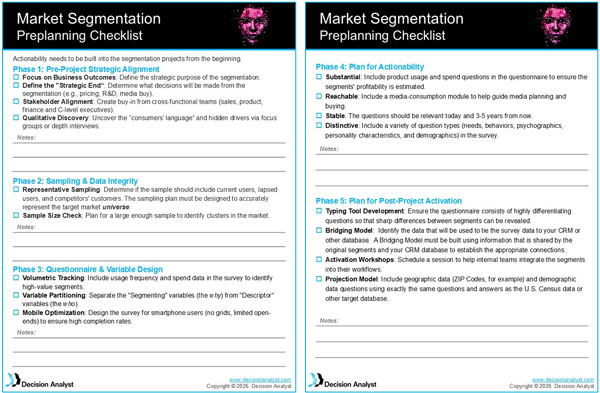
Market segmentation studies have a bad reputation for getting put on a shelf and ignored due to the lack of actionability. If the segments aren’t actionable, then the segmentation is irrelevant.
To ensure your next segmentation project drives revenue, the work must begin before the questionnaire is drafted. Actionability is engineered in the pre-survey phase and planning.
Download your free copy of the Market Segmentation Preplanning Checklist.
Advanced Analytics Team


Audrey Guinn, Ph.D.
Statistical Consultant

Chris Hammack
Sr. Statistical Consultant
We Are Here To Help
Decision Analyst is a global research and analytics consulting firm with almost five decades of experience in advanced analytics, modeling, simulation, and optimization.
We pride ourselves on delivering implications and recommendations based on facts, objective evidence, truth–so that our Clients can make informed and confident decisions to grow their businesses and their brands.
Newsletter
Signup to receive our Create Winning Strategies Newsletter!