

| Advanced Analytics
MaxDiff versus Choice Modeling
Ranking versus Optimization
What is the difference between MaxDiff and Choice Modeling? When and how to use each?
While MaxDiff (Maximum Difference Scaling) is classified as part of the "Choice Modeling" family, there are distinct differences between a MaxDiff analysis and choice modeling techniques (such as Discrete Choice or Conjoint Analysis) regarding their specific objectives, respondent tasks, and the depth of market simulation they provide
MaxDiff
MaxDiff is primarily a ranking tool. It is designed to produce a full, relative ranking of a list of items based on preference or importance.
MaxDiff Respondent Task
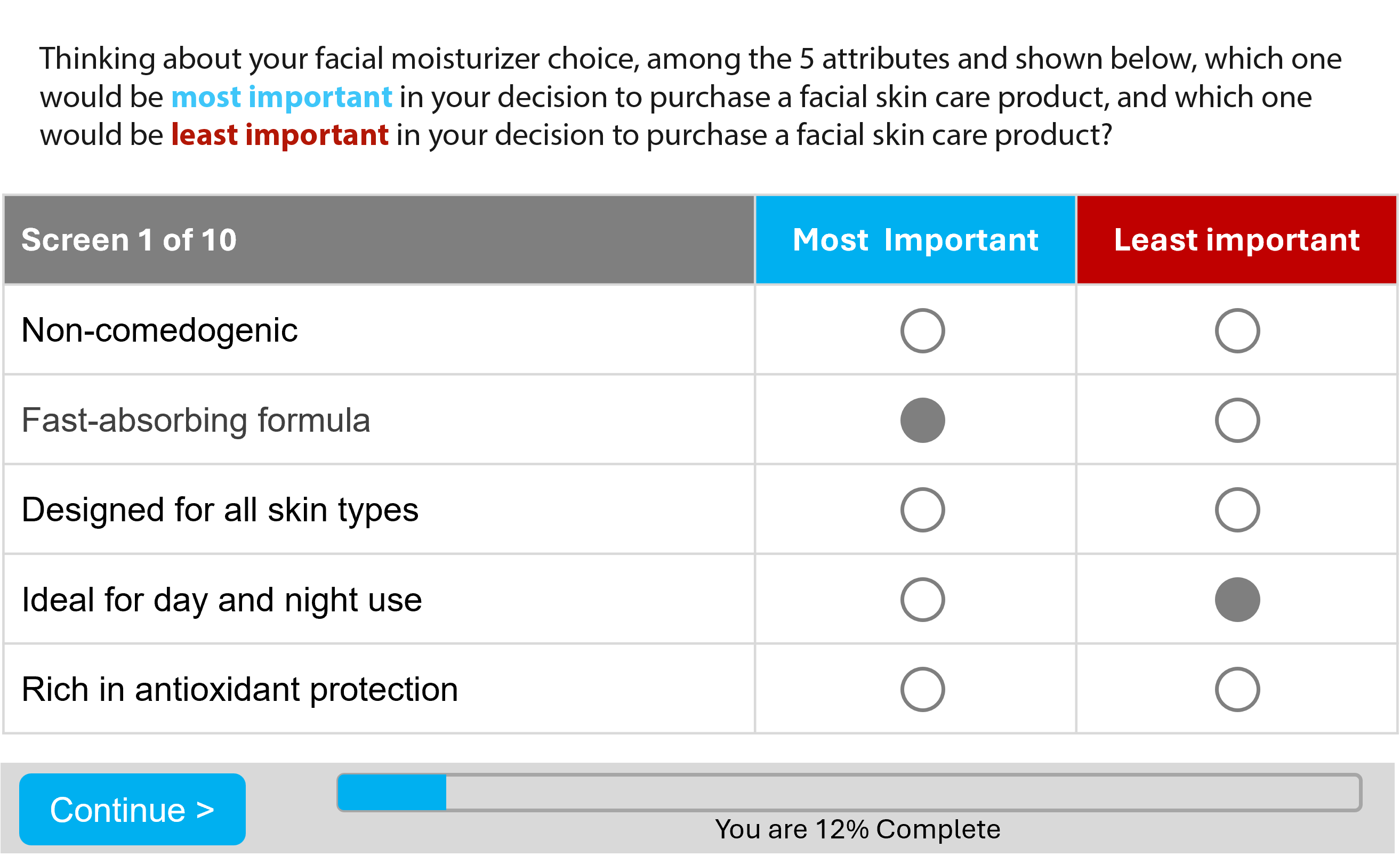
MaxDiff is a simpler and more focused task for respondents than other methods. For example, respondents are shown a subset of items (e.g., 5 facial skincare attributes out of a total list of 20) and asked to select only two: the "Most Important" and the "Least Important" (or "Most Preferred" and "Least Preferred"), as shown below.
Example MaxDiff Question
Benefits of MaxDiff
- Effectively discriminates between attributes or messages to find clear winners and losers.
- Reduces the cognitive burden on respondents; that is, the respondent sees a series of short attribute lists, rather than one long overwhelming list.
- Is excellent for eliminating rating-scale biases (e.g., language and cultural differences across countries).
MaxDiff Drawbacks
- Generally omits competitive effects and brand-price interactions, and it cannot measure cannibalization within a product line.
MaxDiff Best Uses
MaxDiff is ideal for sorting through a large number of single-variable items to determine which are most motivating, most important, most preferred, etc. Examples include:
Ranking: MaxDiff can produce a relative ranking of product claims, positionings, flavors, product varieties, and so on. MaxDiff modeling produces a probability that each item will be selected as "most" from a set of items.
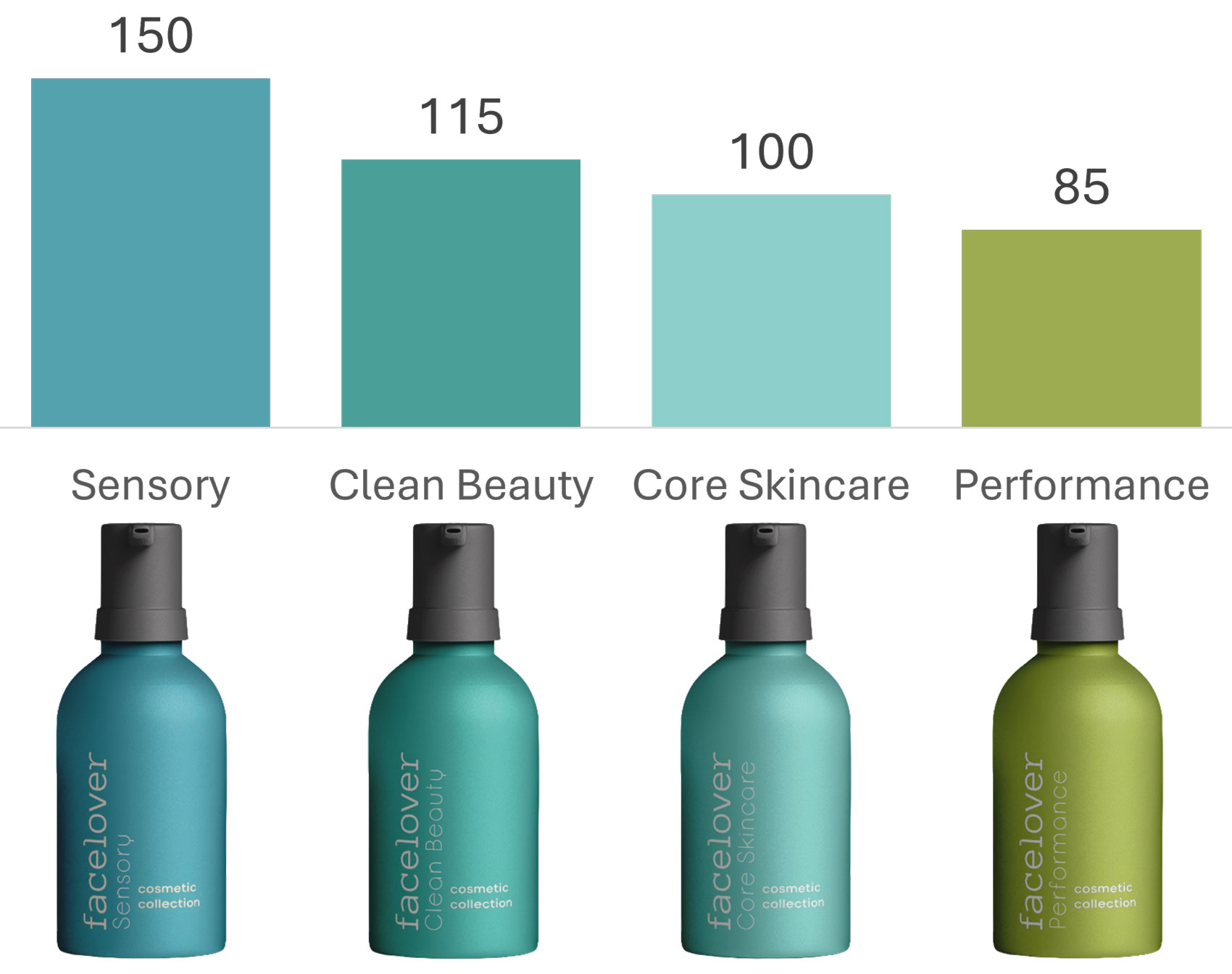
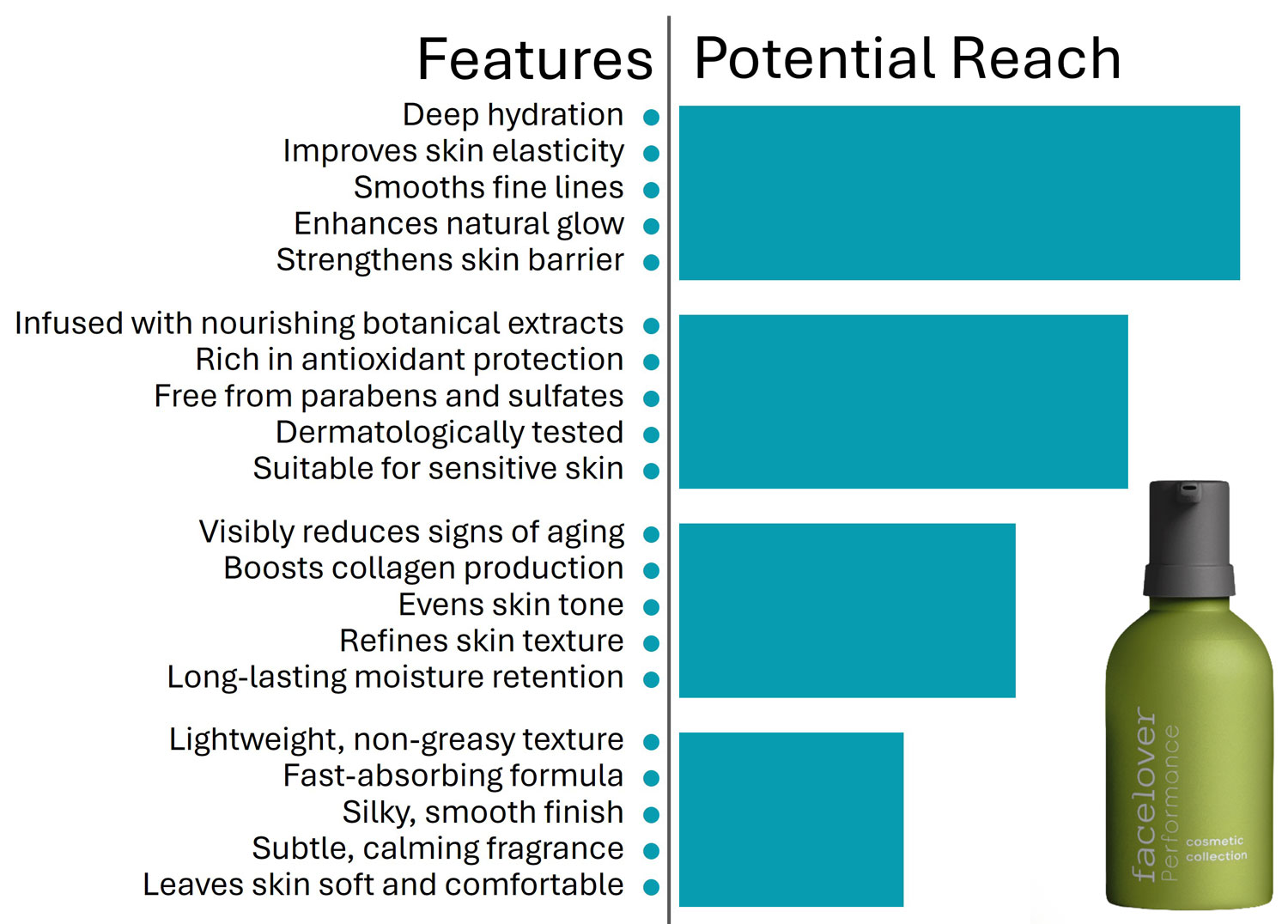
Optimization: The results derived from the MaxDiff can be used to develop optimal combinations or optimal sets of items.
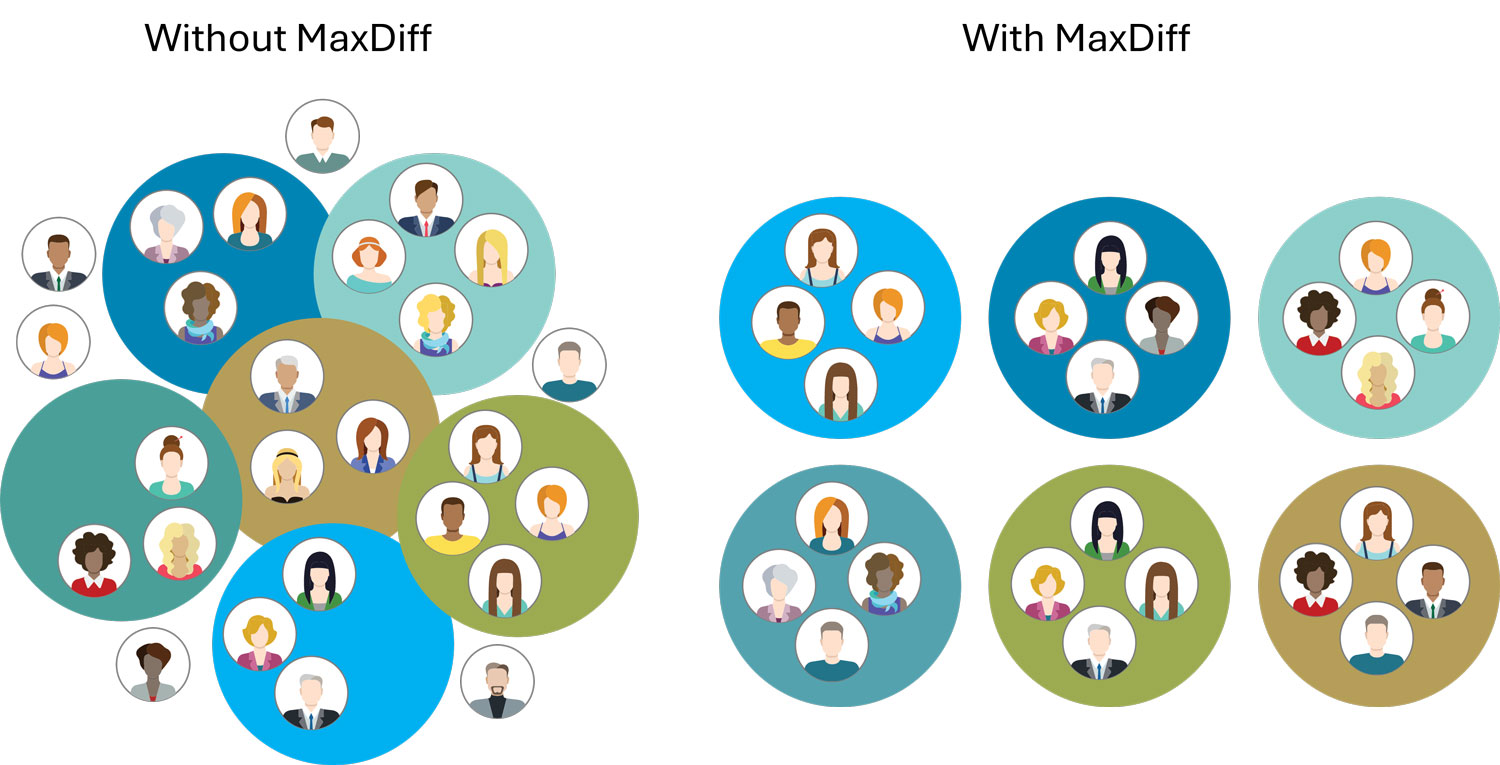
Segmentation: The MaxDiff survey task forces respondents to make choices, and therefore makes it a useful tool in segmentation.
Choice Modeling Optimization
Choice Modeling is designed to mimic the act of shopping and making purchase decisions. The results are used to build simulation models to predict market share, unit sales, or sales revenue as a function of various marketing inputs.
Choice Modeling Respondent Tasks
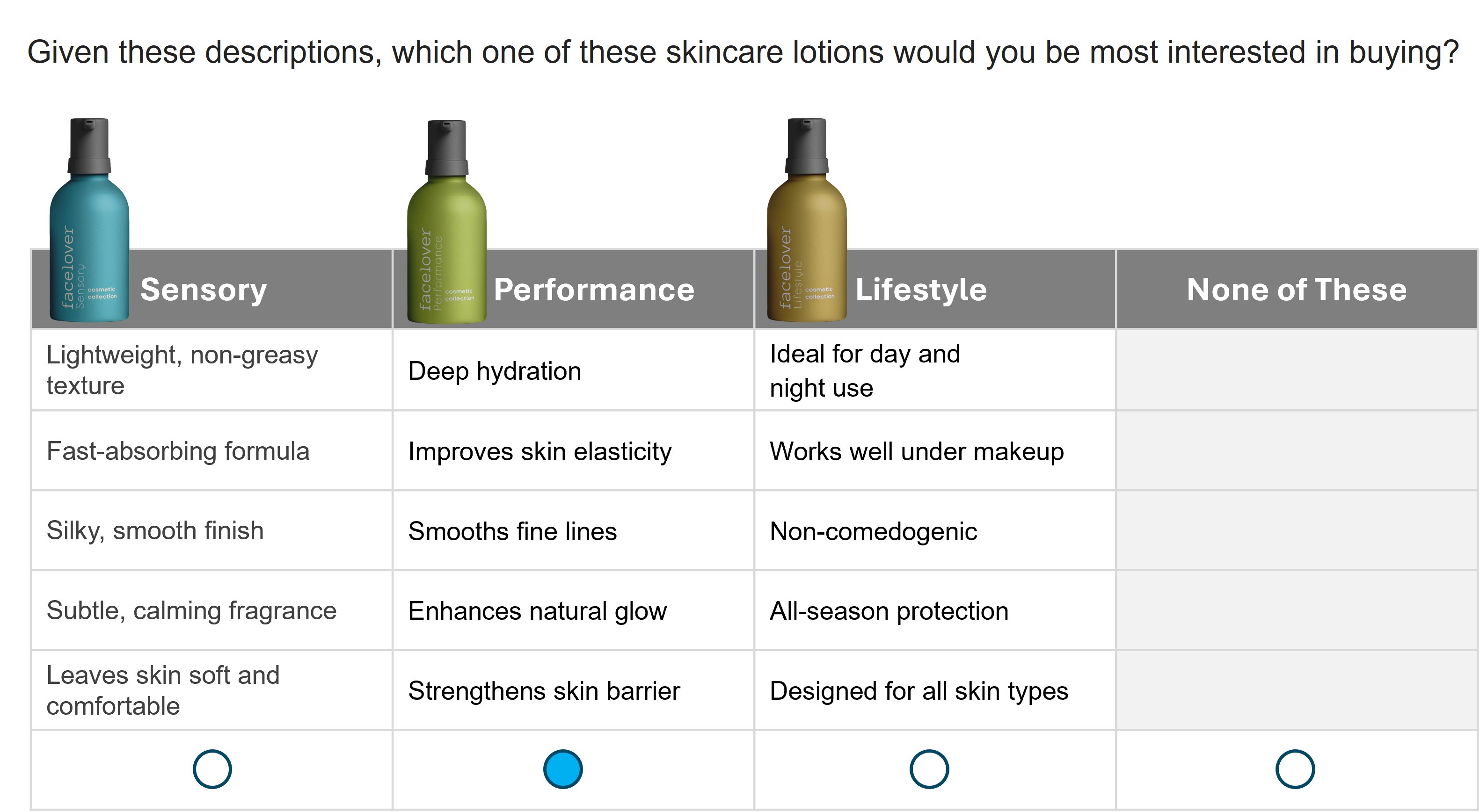
The Choice Modeling tasks are realistic and follow an experimental design. Respondents are presented with real-world "scenarios"—sets of competing products with varying prices and features—and are asked to make purchasing decision(s).
Example Choice Modeling Question
Benefits of Choice Modeling
- It captures the complexity of decision-making by forcing consumers to trade off various features and prices against one another.
- It provides brand-specific price sensitivity (elasticity) and accounts for the impact of competitors.
- It allows a brand to reach the broadest audience without redundancy, leading to more impactful advertising campaigns.
- It can help optimize marketing spend and market penetration.
Choice Modeling Drawbacks
- Choice modeling can only measure attributes and features included in the exercise.
- Choice modeling is more difficult to design and more costly to implement than MaxDiff.
Choice Modeling Best Uses
Choice Modeling is best for:
- Pricing Optimization
- Product Design Optimization
- Product-Line Planning
- Market Segmentation
- Brand Strategy Optimization
- Package Design Optimization
- Advertising Optimization
- New Product Concept Optimization
- Promotion Offer Optimization
Choice Modeling Output
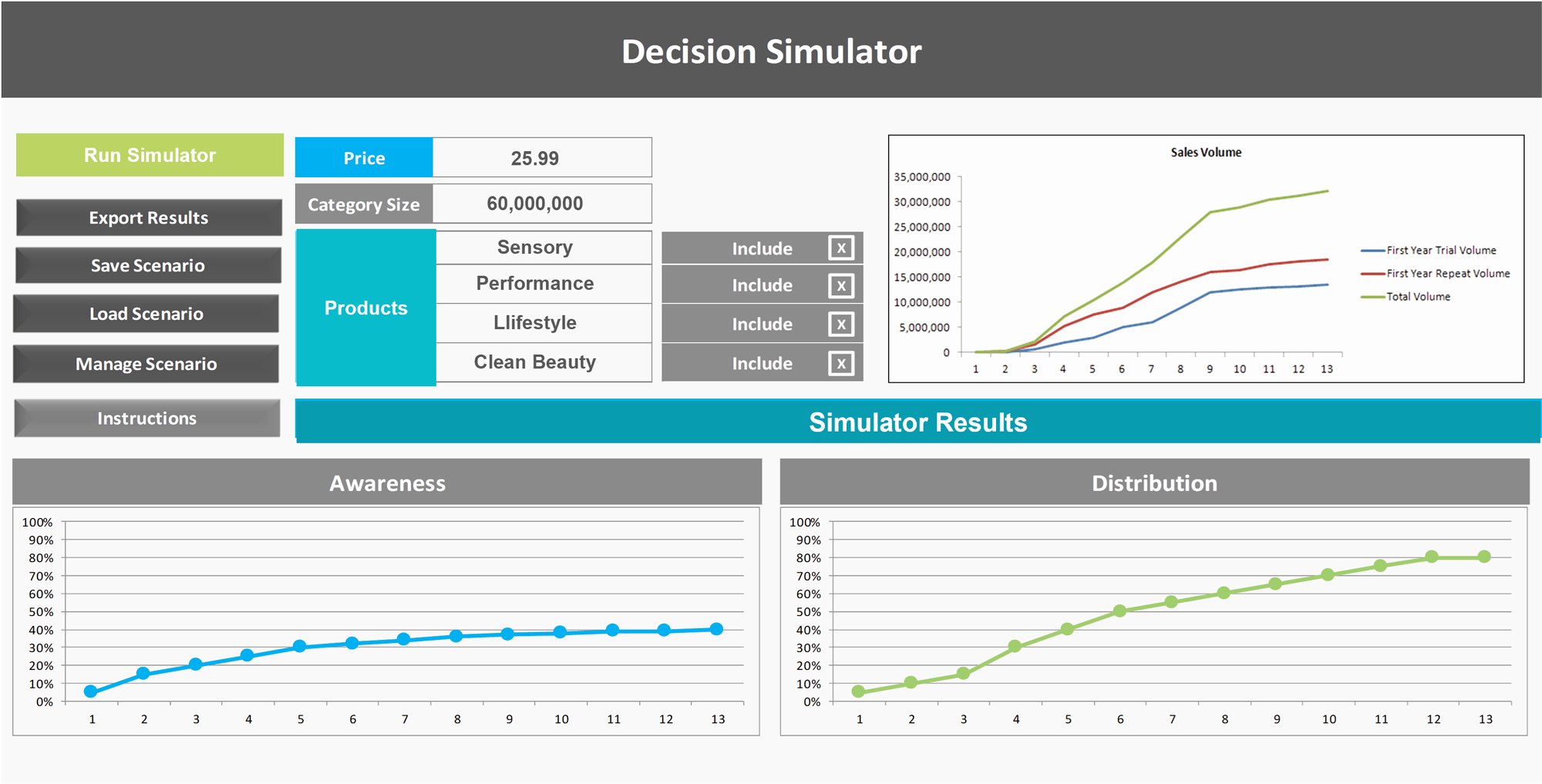
The results of the choice model derived from experimental data are translated into an interactive DecisionSimulator™ with a simple point-and-click interface that allows “what if” scenarios to be explored. By changing inputs (pricing, promotion, product features, competitive variables, etc.), a full range of marketing decisions and competitive responses can be explored.
Example Decision Simulator
Download our MaxDiff vs Choice Modeling pdf.
Advanced Analytics Team


Audrey Guinn, Ph.D.
Statistical Consultant

Chris Hammack
Sr. Statistical Consultant
We Are Here To Help
Decision Analyst is a global research and analytics consulting firm with almost five decades of experience in advanced analytics, modeling, simulation, and optimization.
We pride ourselves on delivering implications and recommendations based on facts, objective evidence, truth–so that our Clients can make informed and confident decisions to grow their businesses and their brands.
Newsletter
Signup to receive our Create Winning Strategies Newsletter!