
More Than A Hot Mess: Emotions In Decision-Making
It’s Only Logical. Or Is It?
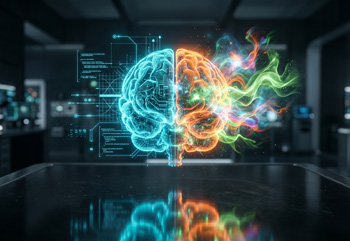
When I was younger, I loved watching re-runs of the original Star Trek. I was fascinated with the logical, non-emotional science officer, Mr. Spock. He was rational, almost robotic, in his thinking. Spock’s cool logic was the perfect foil to the hotly intense feelings of Captain James T. Kirk. Together they navigated “strange new worlds”— Spock advocating logic above all else and Kirk insisting that messy human emotions had their place. Predictably, Spock was difficult to convince. Feelings make humans prone to poor choices and, as such, the absence of feelings should encourage better ones. Spock could not have been more wrong.
Eventually a neuroscientist named Antonio Damasio, through study of patients with damaged emotional centers in the brain, discovered that the key to making decisions is emotion1. One subject, in particular, “Elliot,” had suffered significant damage to a part of the brain known for regulating affect (emotions). In one striking example, Elliot spent over 30 minutes trying to decide whether to use a blue or a black ink pen to sign a check. Worse than that, without the benefit of affective feedback from previous decisions, Elliot repeatedly made the same poor decisions. Stress and tiredness degraded Elliot’s decision-making ability further by suppressing his only avenue, logic. Damasio concluded from his research that emotions are needed to make decisions, even trivial ones.
Emotions Are Key
Elliot is an extreme example of how choices can’t be made without access to emotions. Humans rely on their emotional brain centers to navigate the world, whether choosing what to have for breakfast to determining what to buy at the store. But given that emotions are key, why do we persist in framing decision processes as objective and logical?
Some of the blame lies with how decision drivers are studied. It’s impractical to subject hundreds or thousands of consumers to MRIs and CAT scans to see which brain regions are correlated with which emotional states. Instead researchers rely on stated or derived importance via surveys, which have well-documented biases. These biases overly emphasize the rational drivers of product selection at the expense of the emotional ones. For example, when justifying a decision after the fact, consumers will often default to logical, functional reasons (i.e., Spock responses), such as “the product fits my budget” or “it’s easy to use.” This is known as post-hoc rationalization. Rarely will consumers articulate emotional reasons (i.e., Kirk responses), such as “the product made me feel nostalgic for summer vacations as a child.” Emotions are more difficult to voice, even if they are known to consumers.
Advanced Methods For Quantifying Emotional Drivers
Aside from high-tech brain imaging, qualitative methods, such as laddering, are effective tools in uncovering emotional connections with product choices. Qualitative research, however, isn’t effective for measuring drivers at scale. Luckily, researchers can turn to quantitative methods, like the ones below, to provide this rigor.
- Craft emotional product benefits. Instead of testing purely functional product features, include ones that prompt emotional responses. Rather than “We offer 24/7 roadside assistance” try variations like “Your family’s safety is important, so we offer 24/7 roadside assistance” and “We offer 24/7 roadside assistance for your peace of mind.” These attributes can be tested in a MaxDiff or conjoint to produce importance rankings.
- Present emotional buying scenarios. Prime consumers with emotionally-charged contexts. To evoke feelings of family and happiness, ask them to imagine that they are buying products for a treasured relative’s birthday. To measure the impact of anxiety, ask consumers to imagine the last time their washer stopped working as they evaluate new washing machines. Emotional impact can be measured for each context and the most impactful ones identified. Brands can then tailor product features, pricing, assortment, and messaging to meet key emotional needs.
- Use biometric feedback. This option relies mostly on non-imaging technology, such as eye tracking, facial action coding, and galvanic skin response. Eye tracking, for example, records the areas of a shelf/product that consumers focus on. The rationale is that these highly tracked regions are emotionally evocative. The evidence for the correlation between attention (focus) and feelings is weak at best, though. Facial action coding does a bit better at identifying microexpressions that indicate affective states. Although any biofeedback technology can be costly and time consuming to use, there are brands that won’t launch a new product without using it.
- Leverage in-the-moment debriefing. In-the-moment qualitative probing can be more effective at encouraging consumers to report emotional drivers. These AI-driven conversations can be triggered immediately after a product choice has been made in a survey, which makes this technology easy to scale.
Human decisions, whether life-altering or mundane, never rely purely on “Spock-like” logic. "Kirk-like" emotion also plays a vital role. Mapping both the rational and the emotional drivers of buying behavior is non-negotiable for sustainable brand growth. While no single research method is perfect, advanced techniques can help brands leverage both cold reason and raw human emotion to promote sales.
References
- Damasio, A. R. (1994). Descartes' error: Emotion, reason, and the human brain. G. P. Putnam's Sons.
Author

Elizabeth Horn
Senior VP, Advanced Analytics
Beth has provided expertise and high-end analytics for Decision Analyst for over 25 years. She is responsible for design, analyses, and insights derived from discrete choice models; MaxDiff analysis; volumetric forecasting; predictive modeling; GIS analysis; and market segmentation. She regularly consults with clients regarding best practices in research methodology. Beth earned a Ph.D. and a Master of Science in Experimental Psychology with emphasis on psychological principles, research methods, and statistics from Texas Christian University in Fort Worth, TX.
Copyright © 2026 by Decision Analyst, Inc.
This posting may not be copied, published, or used in any way without written permission of Decision Analyst.